
Advanced Diploma in Financial and Foreign Accounting with Data Analytics
A comprehensive accounting program covering Indian and foreign accounting, GST, Tally, and data analytics — for degree holders targeting global finance careers.

859-3030-111
Join Skillspark’s Diploma in Human Resource Management — Kerala’s most practical and comprehensive HR course covering AI-integrated HR operations, Advanced Excel, Power BI, Labour Laws, and hands-on HR practicals. Available at our Kollam, Trivandrum, and Kochi centres and also online. Earn International Certification from the American Board of Education with 100% placement support for HR careers in Kerala and the Gulf.

Upgrade your skills and be competent for the on demand jobs with this Diploma in Human Resource Management Course
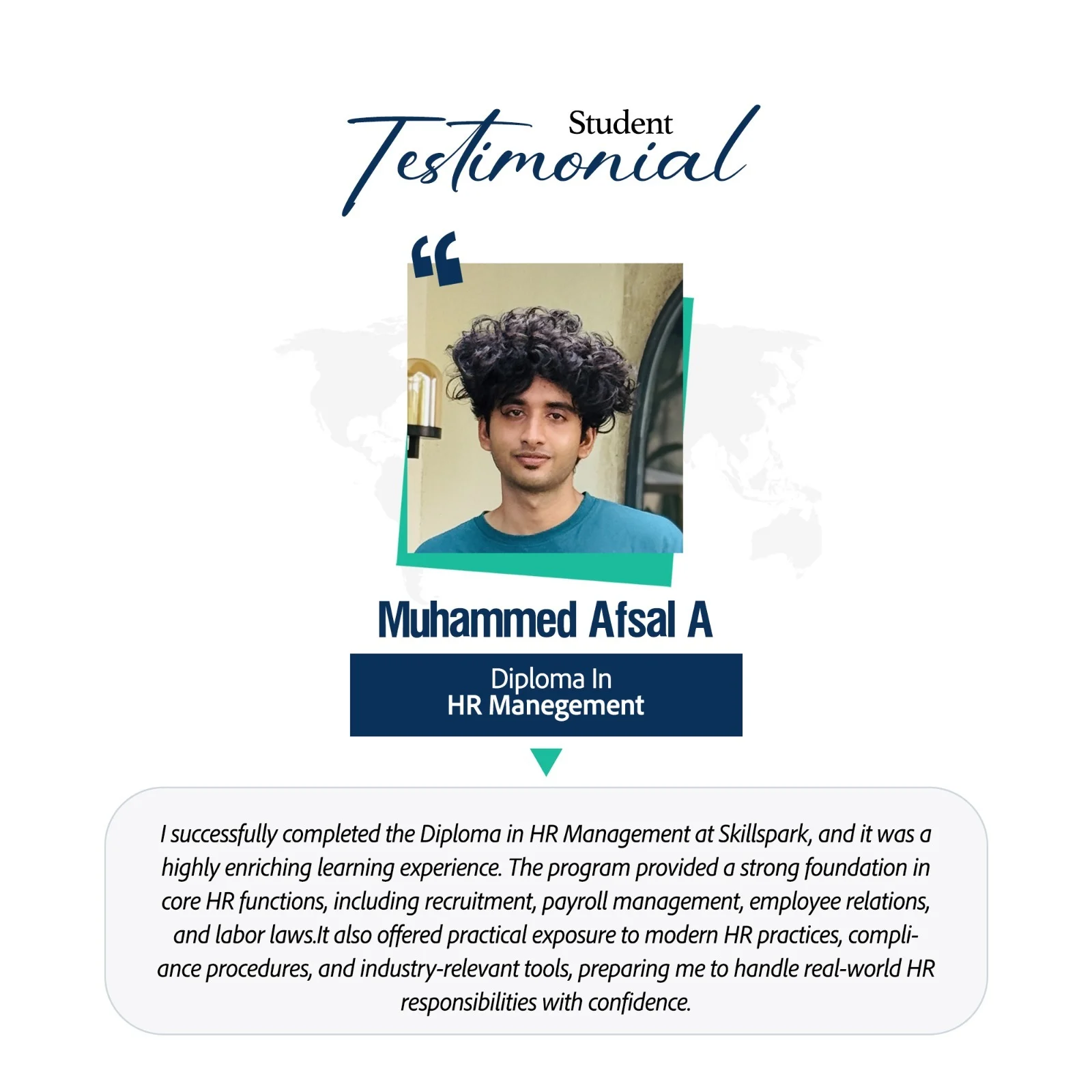
This 6-month program covers 11 practical modules — from Microsoft 365 for HR and AI Prompt Engineering to Power BI, Labour Laws, HR Practicals, and pre-placement coaching — making it the most comprehensive HR Management course available in Kerala with American Board of Education International Certification.
| # | Module | Key Topics Covered |
|---|---|---|
| 1 | Microsoft 365 for Modern HR Management | Office 365 for HR operations, cloud-based HR workflows, OneDrive, Teams, HR data handling, collaboration tools, data privacy |
| 2 | AI Prompt Engineering for HR Management Professionals | AI tools for HR tasks, prompt frameworks for job descriptions, interview questions, HR policies, performance reviews, payroll summaries |
| 3 | Office AI Accelerator | Grammarly, QuillBot, Canva, Otter.ai, ChatGPT, Microsoft Copilot — AI tools for daily HR productivity and document automation |
| 4 | Advanced Excel for HR Operations | Attendance trackers, salary sheets, leave management, employee databases, pivot tables, VLOOKUP, HR dashboards |
| 5 | Professional Dashboards for Automated HR Works | Design and build HR dashboards for headcount, attrition, recruitment, and performance reporting |
| 6 | Data Analytics Using Power BI for HR Visualisation | HR data import, Power Query, DAX functions, interactive HR dashboards, attrition analysis, workforce analytics |
| 7 | HR Practical Training Modules | Recruitment, onboarding, payroll processing, leave management, performance appraisal, employee relations, exit process |
| 8 | Labour Laws & HR Policy Creation (India & UAE) | Indian Labour Laws, UAE Labour Law, ESI, PF, gratuity, HR policy drafting, employee handbook, compliance |
| 9 | Soft Skills and Employability | CV preparation, STAR method, LinkedIn profile, interview skills, professional communication, workplace etiquette |
| 10 | Project | Real-world HR project — recruitment drive, HR dashboard, policy document, or payroll simulation |
| 11 | Pre-Placement Training | Interview coaching, grooming, business communication, professional profiles, mock interview with feedback |
Module 1: Office 365 Fundamentals for HR Operations
Topics Covered:
Introduction to Microsoft Office 365 | HR digital workplace overview | Cloud-based HR operations | Office 365 apps for HR | Web vs desktop applications | HR data handling basics | OneDrive integration | Collaboration principles | Version control | Data privacy and confidentiality standards
Pain Point:
HR professionals use multiple tools without an integrated digital workflow.
How It Helps:
Builds a clear understanding of how Office 365 supports end-to-end HR operations.
Industry Impact:
Most organizations rely on Microsoft 365 as the primary HR productivity platform.
Practical Projects:
HR digital workspace setup | HR document workflow mapping | HR data security checklist
Module 2: Microsoft Word for HR Documentation
Topics Covered:
Offer letters | Appointment letters | Confirmation letters | Experience letters | Warning letters | HR policies | Employee handbooks | Circulars | Notices | Letterhead design | Standard HR templates | Styles and formatting | Tables | Headers and footers | Track changes | Comments | Mail merge | PDF conversion | Document protection | Version control
Pain Point:
HR teams spend excessive time preparing repetitive employee documents.
How It Helps:
Creates standardized HR document formats and automates document generation.
Industry Impact:
Accurate documentation is legally critical in HR management.
Practical Projects:
HR letter template library | Employee document automation | Policy document creation
Module 3: Microsoft Excel for HR Data Management
Topics Covered:
Employee master database | Attendance tracking | Shift management | Leave management | Payroll input preparation | Salary structure sheets | Incentive tracking | Overtime calculation | HR formulas | Logical functions | Lookup functions | Conditional formatting | Data validation | Pivot tables | HR dashboards | Attrition tracking | Data cleaning | Sheet protection
Pain Point:
Manual HR tracking leads to calculation errors and data inconsistency.
How It Helps:
Automates HR records, improves accuracy, and simplifies reporting.
Industry Impact:
Excel remains the backbone of HR analytics and payroll coordination.
Practical Projects:
Employee master tracker | Attendance and leave automation | HR MIS dashboard
Module 4: Microsoft PowerPoint for HR Communication
Topics Covered:
HR presentations | Induction programs | Orientation decks | HR policy presentations | Training slides | Performance review presentations | Employee engagement decks | Charts and visuals | SmartArt | Infographics | Slide master | Branding templates | Storytelling for HR | Executive HR reporting
Pain Point:
HR presentations often lack clarity and professional design.
How It Helps:
Enables structured communication and visually effective HR presentations.
Industry Impact:
Professional HR communication strengthens employer branding and engagement.
Practical Projects:
Employee induction presentation | HR policy presentation | Training workshop deck
Module 5: Microsoft Outlook for HR Communication & Coordination
Topics Covered:
Professional HR email writing | Interview communication | Candidate follow-ups | Interview scheduling | Calendar management | Shared calendars | Meeting invites | Task tracking | Email rules | Automated responses | Email templates | HR signature standards | Confidential email handling | Integration with Teams and OneDrive
Pain Point:
High email volume causes missed interviews and delayed responses.
How It Helps:
Improves interview coordination, communication speed, and organization.
Industry Impact:
Outlook is the primary HR communication channel in most organizations.
Practical Projects:
Interview scheduling system | HR email automation rules | Recruitment communication workflow
Module 6: OneDrive for HR File Management & Security
Topics Covered:
HR folder structuring | Employee document storage | Offer and payroll file management | Secure sharing | View and edit permissions | Role-based access | Version history | File recovery | External sharing controls | Audit tracking | Backup practices | Integration with Office apps
Pain Point:
HR data security risks due to improper file storage.
How It Helps:
Ensures secure, organized, and compliant HR document management.
Industry Impact:
Data privacy and access control are mandatory HR compliance requirements.
Practical Projects:
HR department folder architecture | Secure employee file-sharing model | HR document audit system
Module 7: Integrated HR Workflow Using Microsoft 365
Topics Covered:
Employee lifecycle documentation | Recruitment workflow integration | Onboarding documentation | Attendance-to-payroll coordination | HR reporting workflow | Excel-to-PowerPoint HR dashboards | Outlook-based approvals | Cloud collaboration | Best HR productivity practices
Pain Point:
HR processes are fragmented across tools and files.
How It Helps:
Demonstrates complete HR workflows using integrated Office 365 tools.
Industry Impact:
Integrated digital HR operations improve compliance, efficiency, and accuracy.
Practical Projects:
End-to-end HR lifecycle workflow | HR onboarding system | HR reporting automation model
Topics Covered:
Overview of AI in HR | What is Generative AI | Role of AI in recruitment and people management | AI tools landscape (ChatGPT, Copilot, Gemini) | Understanding automation opportunities in HR | Identifying repetitive tasks suitable for AI | AI risks and limitations | Ethical use of AI
Pain Point:
HR teams often feel overwhelmed by administrative workload and unsure where AI can realistically help without replacing human judgment.
How It Helps:
Provides clarity on where AI fits in daily HR workflows and helps identify quick-win automation opportunities.
Industry Impact:
Creates future-ready HR professionals who understand AI capabilities and can lead digital transformation initiatives.
Practical Projects:
AI opportunity mapping exercise | HR task automation checklist | AI readiness assessment
Topics Covered:
Importance of prompt technology | How AI understands instructions | Structure of effective prompts | Role-based prompting | Context-setting prompting | Constraint prompting | Scenario prompting | Iterative refinement | Avoiding common prompting mistakes | Prompt templates for HR
Pain Point:
Many HR professionals use AI but get inconsistent or generic results due to unclear instructions.
How It Helps:
Teaches structured prompting methods to generate accurate HR documents, insights, and communication consistently.
Industry Impact:
Improves productivity and reduces dependency on manual drafting across HR operations.
Practical Projects:
Prompt writing workshop | Prompt improvement exercises | HR communication generation lab
Topics Covered:
AI-powered job description creation | Resume screening using AI | Candidate evaluation frameworks | Interview question generation | Bias reduction using structured prompts | Interview scheduling automation | Candidate communication templates | Recruitment workflow automation
Pain Point:
Recruitment is time-consuming and prone to bias, especially during resume screening and candidate evaluation.
How It Helps:
Reduces screening time and improves candidate assessment consistency using structured AI workflows.
Industry Impact:
Enables faster hiring cycles and improves quality of hires.
Practical Projects:
AI resume screening simulation | Interview question generator | Recruitment workflow automation design
Topics Covered:
AI in onboarding processes | Creating onboarding checklists | Employee engagement communication | Policy drafting with AI | Training content generation | AI for performance review preparation | Feedback analysis | Employee query automation
Pain Point:
HR teams spend excessive time creating documentation and managing employee communications manually.
How It Helps:
Automates documentation and improves employee experience through faster and clearer communication.
Industry Impact:
Improves employee satisfaction and operational efficiency across the employee lifecycle.
Practical Projects:
Onboarding workflow design | Policy drafting exercise | Performance review template creation
Topics Covered:
Using AI for HR data analysis | Sentiment analysis from employee feedback | Attrition risk indicators | Workforce insights generation | Survey analysis using AI | Predictive HR scenarios | KPI tracking | HR reporting automation
Pain Point:
HR teams often collect data but struggle to extract meaningful insights for decision-making.
How It Helps:
Transforms raw HR data into actionable insights without needing advanced analytics skills.
Industry Impact:
Supports strategic HR planning and improves workforce management decisions.
Practical Projects:
Employee feedback sentiment analysis | Attrition risk analysis scenario | HR dashboard planning
Topics Covered:
Introduction to workflow automation | Using Zapier for HR workflows | Automating approvals and notifications | Document automation | Integration between HR tools | Workflow design principles | Automation governance | ROI of automation
Pain Point:
Manual coordination across tools leads to delays, missed communications, and inefficiencies.
How It Helps:
Creates automated workflows that reduce manual effort and improve process reliability.
Industry Impact:
Builds scalable HR operations and improves productivity.
Practical Projects:
HR workflow automation blueprint | Approval automation design | Communication automation setup
Topics Covered:
PDF merging and splitting | Extracting data from PDFs | OCR tools for HR records | E-signature workflows | Document organization best practices | Digital HR documentation | Compliance document handling
Pain Point:
HR teams handle large volumes of documents manually, leading to delays and errors.
How It Helps:
Improves efficiency in document processing and ensures organized digital records.
Industry Impact:
Enhances compliance readiness and operational speed.
Practical Projects:
Offer letter document workflow | PDF data extraction exercise | Digital file organization setup
Topics Covered:
Responsible AI use in HR | Data privacy considerations | Avoiding bias in AI outputs | Human oversight models | AI policy framework | Change management | Future HR skills | Building an AI adoption roadmap
Pain Point:
Organizations worry about compliance, fairness, and ethical risks when adopting AI.
How It Helps:
Provides governance frameworks to safely implement AI in HR processes.
Industry Impact:
Builds trust in AI adoption and prepares organizations for future workforce transformation.
Practical Projects:
AI governance checklist | Ethical risk assessment | HR AI adoption roadmap
Topics Covered:
End-to-end HR AI implementation plan | Workflow automation design | Prompt library creation | HR analytics insights presentation
Pain Point:
Learning often remains theoretical without real-world application.
How It Helps:
Allows learners to apply all concepts to a realistic HR scenario.
Industry Impact:
Demonstrates practical AI capability to employers and leadership teams.
Practical Projects:
Complete HR automation strategy | AI-powered recruitment workflow | HR analytics presentation
The project will be selected by the student based on their area of interest or relevant industry domain. It should reflect the practical application of the HR concepts, tools, and techniques learned during the course.
Most HR courses in Kerala cover only theoretical HR concepts — without AI tools, Power BI, Labour Laws, or hands-on HR practicals. Skillspark’s Diploma in Human Resource Management goes significantly further — integrating AI Prompt Engineering, Microsoft 365, Power BI dashboards, Advanced Excel, UAE Labour Law, and comprehensive HR practicals into a single 6-month internationally certified program.
Skillspark’s Diploma in Human Resource Management is Kerala’s most comprehensive HR training program — covering Microsoft 365 for HR, AI Prompt Engineering, Power BI, Advanced Excel, HR Practicals, Labour Laws, and professional development in one 6-month internationally certified program. Graduates earn International Certification from the American Board of Education with 100% placement support for HR careers across Kerala and the Gulf.
Human Resources is one of the fastest-growing professional functions across Kerala — in IT companies, hospitals, schools, manufacturing firms, and Gulf organisations. Modern HR professionals need more than recruitment knowledge — they need AI tools, data analytics, Excel dashboards, Power BI, and Labour Law expertise to compete for high-value HR roles. Skillspark’s HR Management course is built to deliver exactly these skills.
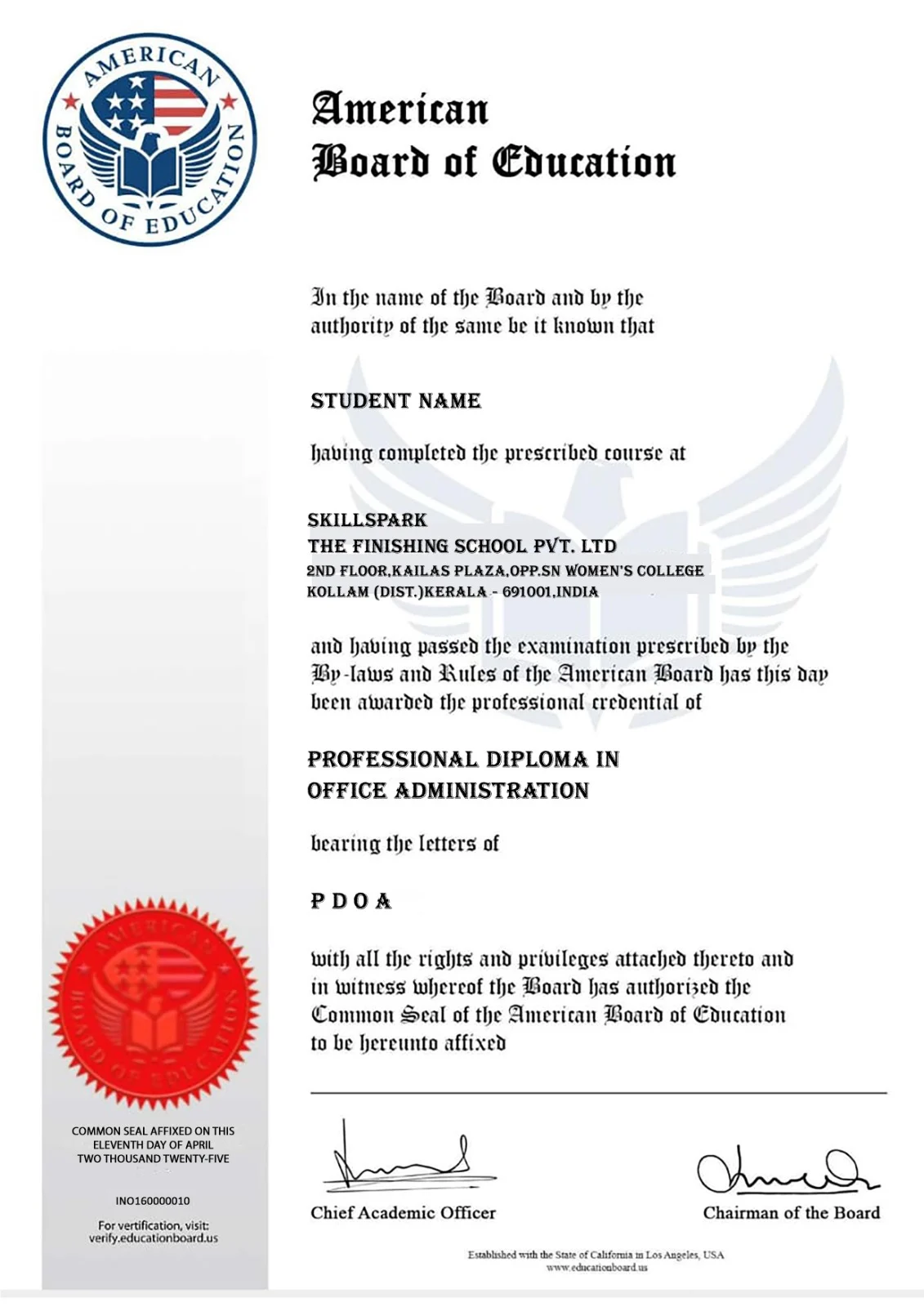
Upon successful completion of this course, you will receive a recognised certificate from our accredited partners.
American Board of Education (ABE) is an international certification body that supports professional education and skill development programs. An ABE certification carries global recognition and international value, validating industry-relevant skills and enhancing learners’ credibility and career opportunities in both national and international job markets.

Skillspark’s Diploma in Human Resource Management is open to any degree holder in any stream. No prior HR experience is required. This course is ideal for:

Where These Jobs Are Available: Graduates secure jobs across Kerala — in Kollam, Trivandrum, and Kochi — in IT companies, hospitals, schools, real estate firms, manufacturing companies, and government organisations. Technopark in Trivandrum and Infopark and SmartCity in Kochi are the largest HR employers in Kerala. Gulf HR roles in UAE, Qatar, and Saudi Arabia are actively recruited from Kerala.
Salary Range: Entry-level HR roles in Kerala start at ₹15,000–₹25,000 per month. HR Analysts and HR Business Partners in Technopark and Infopark companies earn ₹25,000–₹50,000 per month. Gulf HR roles offer tax-free salaries from AED 3,000–8,000 per month (approximately ₹65,000–₹1,75,000 per month).
Graduates from Skillspark’s HR Management course secure jobs as HR Executives, Recruitment Executives, HR Assistants, Payroll Executives, HR Analysts, and HR Business Partners — in IT companies, hospitals, schools, manufacturing firms, and Gulf organisations across Kerala, India, and abroad.
The HR Management course is 6 months — covering 11 practical modules from Microsoft 365 for HR and AI Prompt Engineering to Power BI, Labour Laws, HR Practicals, and pre-placement coaching. Available as classroom training at our Kollam, Trivandrum, and Kochi centres and also online.
Graduates receive the American Board of Education International Certificate — an internationally recognised HR qualification valued by MNCs, Gulf employers, and global companies hiring HR professionals from Kerala.
Yes. Skillspark’s HR Management course is available at our Chinnakkada, Kollam centre; Pattom Junction, Trivandrum centre; and Kochi centre — and also online for students anywhere in Kerala or abroad.
No. The course is open to any degree holder in any stream. It starts from foundational HR concepts and builds up to AI-integrated HR operations, Power BI analytics, and Labour Law compliance — making it suitable for complete beginners.
Yes. The course includes a dedicated AI Prompt Engineering for HR Professionals module and an Office AI Accelerator module — covering ChatGPT, Microsoft Copilot, Grammarly, Canva, and Otter.ai for HR tasks. This is unique to Skillspark and not available in most HR courses in Kerala.
Yes. The Labour Laws and HR Policy Creation module covers both Indian Labour Law and UAE Labour Law — including ESI, PF, gratuity, UAE employment contracts, and HR policy drafting. This directly prepares graduates for HR roles in Gulf companies — a critical differentiator for Kerala professionals targeting Gulf HR careers.
Yes. The course includes Data Analytics Using Power BI for HR Visualisation — covering attrition analysis, workforce analytics, headcount dashboards, and interactive HR reporting. This skill is increasingly required by corporate and MNC HR departments and is not available in most HR courses in Kerala.
Yes. The combination of UAE Labour Law, American Board of Education International Certificate, and Power BI HR analytics skills directly prepares graduates for HR roles in UAE, Qatar, and Saudi Arabia — actively recruited from Kerala.
Yes. Skillspark provides 100% placement support — including resume building, LinkedIn profile development, mock interviews using the STAR method, and direct connections to hiring companies across Kerala and the Gulf.
Entry-level HR roles in Kerala start at ₹15,000–₹25,000 per month. HR Analysts and HR Business Partners in Technopark and Infopark companies earn ₹25,000–₹50,000 per month. Gulf HR roles offer tax-free salaries from AED 3,000–8,000 per month.
Graduates work as HR Executives, Recruitment Executives, Payroll Executives, HR Analysts, Labour Law Compliance Officers, and Gulf HR Executives — in IT companies, hospitals, schools, manufacturing firms, and Gulf organisations across Kerala.
A comprehensive accounting program covering Indian and foreign accounting, GST, Tally, and data analytics — for degree holders targeting global finance careers.

Learn SAP MM for procurement and supply chain roles — practical ERP training for degree holders targeting corporates and MNCs.

Industry-leading ERP training in finance and controlling — for degree holders targeting high-paying SAP careers in top companies across India and abroad.

Master India's most widely used accounting software — practical, job-focused Tally training for immediate employment in accounting roles.

Become a certified GST Practitioner — learn to file returns, handle compliance, and advise businesses with confidence across India.

Learn to file GSTR-1, GSTR-3B, and all major returns accurately — an essential skill for every accounting professional in India.

Specialised VAT training for Gulf accounting roles — covering UAE, Bahrain, Saudi Arabia, and Oman VAT regulations and filing procedures.

Specialised accounting training for UAE, Qatar, and Saudi Arabia — covering GCC VAT, Zoho, and foreign accounting standards for Gulf job seekers.

Learn international accounting software used by UK and European companies — ideal for professionals targeting accounting careers outside India.

Start your accounting journey from scratch — beginner-friendly training covering fundamental accounting principles for Plus Two students and freshers.

Learn GST filing and compliance using Zoho Books — practical training in one of the fastest-growing accounting platforms preferred by businesses across India.

Handle VAT filing for Gulf companies using Zoho — practical training for professionals targeting accounting roles in UAE and other GCC countries.

©2026 Skillspark. All rights reserved
| Website designed & Developed by Redwet Solutions